

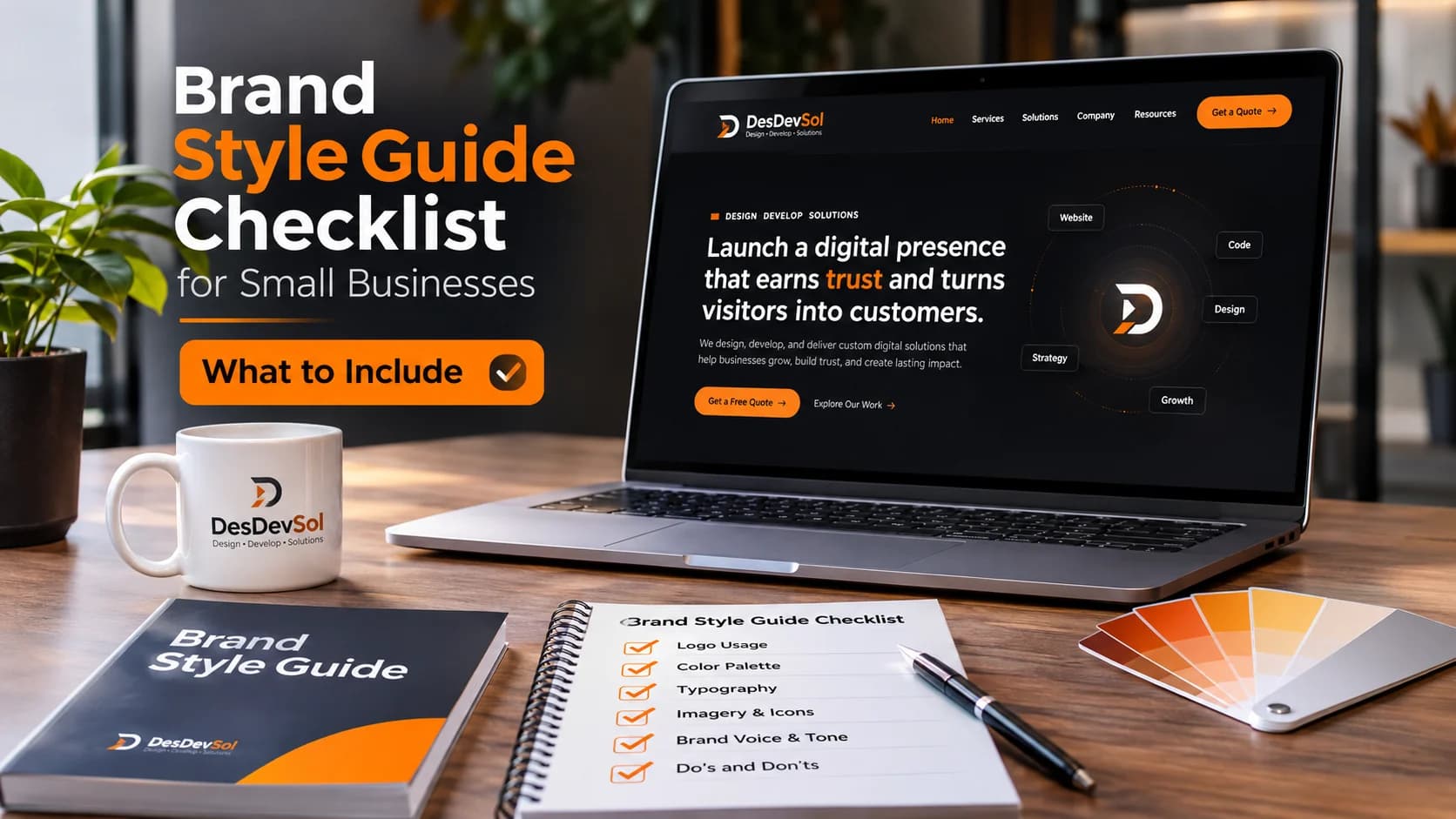
A consistent brand is built from more than an attractive logo. When your website, social posts, proposals, and packaging each use different colors or fonts, customers can struggle to recognize the same business. A brand style guide gives employees, designers, and agencies practical rules they can follow without asking the founder to approve every design choice. This checklist explains what to include, where to start, and how to make the document genuinely usable.
What is a brand style guide?
A brand style guide is a concise reference for visual identity and communication. It normally covers approved logo versions, color values, typography, photography, messaging, and examples of common applications. It should translate your positioning into everyday decisions. An effective guide answers questions such as which logo belongs on a dark background, how headings should look, and how to write a helpful call to action. Adobe's guidance on brand style guides outlines these core building blocks.
1. Define your brand foundation
Begin with the audience you serve, the problems you solve, and your business's distinguishing promise. Write a short brand description and choose three to five personality traits. Explain each trait with behavior rather than vague adjectives. For example, a trustworthy brand might support claims with evidence and avoid exaggerated promises; an approachable brand might avoid unnecessary jargon. Include a few sentences describing how the brand should feel to first-time customers. This one-page foundation helps collaborators understand why design decisions were made.
2. Provide complete logo rules
Include approved primary, stacked, horizontal, and compact logo variants where they exist. Specify clear space, minimum usable size, approved background treatments, and the situations where a single-color variant is appropriate. Add examples of prohibited changes: stretching, rotating, recoloring without approval, or adding shadows. Supply accessible asset files, including vector originals and appropriately sized raster exports. Test the mark on a mobile screen and a print sample. If existing versions cannot meet these needs, consider professional logo design support before freezing the guidelines.
3. Specify colors by role
Document primary, accent, and neutral colors with exact HEX values for digital use. Include applicable print specifications prepared for your printer and process. A swatch alone is not enough: define colors for body text, headings, links, calls to action, backgrounds, and supporting graphics. Test permitted combinations before distributing templates. WCAG 2.2 Level AA generally calls for a contrast ratio of at least 4.5:1 for ordinary text and 3:1 for large text; logos have a specific exception, which should not be treated as a free pass for normal interface text. The W3C WCAG 2.2 standard gives the requirements and exceptions.
4. Establish typography and hierarchy
Specify approved heading and body typefaces, weights, line spacing, and sizes, along with fallback fonts. Provide actual examples of an article headline, section heading, paragraph, button, and caption so contributors can reproduce the hierarchy. Check that your font licenses cover web, desktop, and print uses as needed. If your audience reads more than one language, test the selected typefaces for each writing system. Avoid selecting typefaces purely for decorative appeal when legibility will suffer at smaller sizes.
5. Document imagery and illustration
Describe the style of photography and graphics that best fits the brand. Decide whether photographs should feel candid or staged, what backgrounds are appropriate, how images are cropped, and what editing treatments are acceptable. Establish consistent icon strokes and illustration styles. Provide approved examples and a short list of visual approaches to avoid. Store rights and licensing information alongside the files so team members do not accidentally reuse unlicensed images. A curated library saves more time than a vague direction to use professional-looking photography.
6. Make brand voice actionable
Write guidelines for tone, vocabulary, sentence style, and claims. Include a sample headline, a short service description, a customer email, and a call to action. Show side-by-side examples of suitable and unsuitable language. Avoid broad instructions such as be friendly unless you explain what that means in practice. Decide which technical terms need explanations and how your team handles uncertainty. Customers experience your brand through the words they read as much as through the colors they see.
7. Include reusable business templates
List the assets you produce most frequently, such as proposals, presentation slides, invoices, social posts, brochures, and email signatures. Build editable templates with approved fonts, logos, spacing, and sample content already applied. Tell staff which elements can change and which should remain fixed. For a social-first business, consistent social media creative templates help multiple contributors publish recognizably branded content. Organizations producing print materials can also standardize marketing collateral.
8. Cover website and app components
For digital products, define button styles, form labels, field states, links, cards, and spacing. Provide examples for desktop and mobile screens and check focus visibility as well as text contrast. Different teams should not invent competing versions of the same basic interface component. If your business has several web or application interfaces, a reusable component library created with UI/UX design support can turn brand decisions into consistent real-world experiences.
How to start with a lean guide
You do not need a large corporate brand manual on day one. Start with a one-page brand foundation, approved logos, exact colors, typography rules, writing guidance, and templates for the three most common deliverables. Inventory your customer touchpoints and rank them by frequency and importance. Extend the guide when a genuine need appears, such as packaging, signage, or expanded product interfaces. This approach concentrates effort on the decisions your business actually makes rather than producing decorative pages nobody uses.
How to test and maintain the guide
Ask a colleague unfamiliar with the design process to create a realistic social image or one-page proposal using only the guide and provided files. Record every point at which the colleague must guess. Test the logo in black and white and at small sizes. Review typography on a phone and confirm that intended color combinations remain readable. Revise ambiguous instructions and give the document a version number, named owner, and review date. Keep the approved guide and assets in one shared location, with older files clearly marked as outdated.
Common mistakes to avoid
Do not make the palette so large that contributors cannot choose the correct colors. Do not rely solely on attractive mockups without production rules. Do not neglect image usage rights or font licensing. Avoid specifying visual treatments that work on a large monitor but fail in a small mobile layout or on print. Finally, do not confuse consistency with identical layouts: a recognizable system should adapt to different content and formats without losing its character.
When to expand into a complete identity system
A growing business may need deeper brand strategy and production rules when it hires multiple creative partners, expands into new customer segments, launches products, or rebrands. At that stage, a coordinated brand identity and guidelines project can bring positioning, logo systems, visual assets, messaging, and governance together. The best outcome is not a document that looks impressive on a shelf; it is a system the whole team can apply confidently.
Next step
Collect three recent customer-facing materials and place them next to each other. Check for avoidable differences in the logo, headline styles, colors, and tone. Turn the recurring inconsistencies into the first rules of your guide, then test those rules on an actual deliverable. If you need help creating a cohesive identity, explore DesDevSol's brand identity and guidelines service and plan the assets and templates your business uses most.