

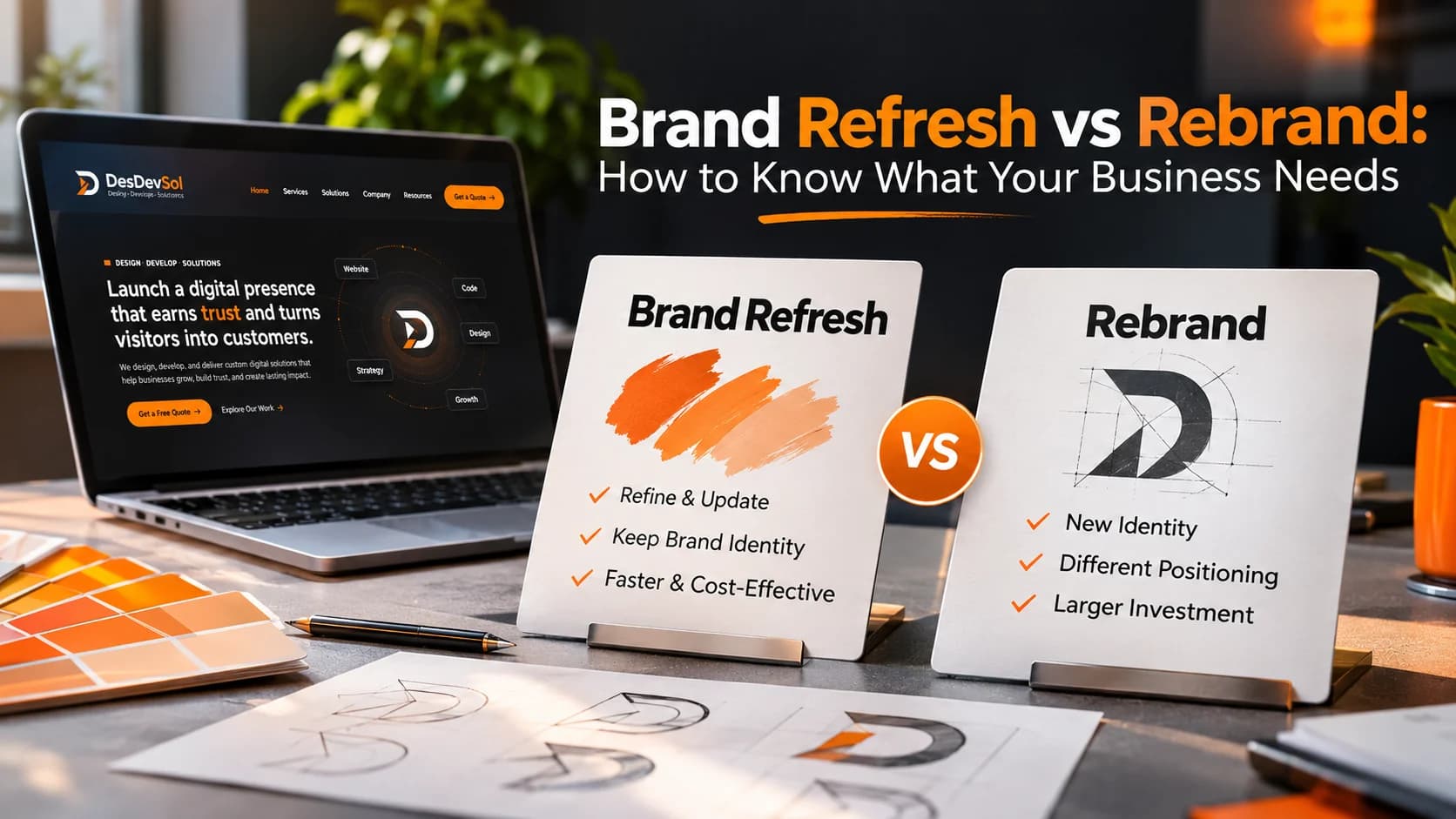
A brand refresh vs rebrand decision is worth making before you commission a new logo, update packaging or redesign your website. If your business still serves the same customers but its visual materials feel inconsistent, a refresh might solve the problem. If your products, audience or promise have changed substantially, a full rebrand may be more appropriate. The difference matters because it affects your budget, rollout and the recognition you have already built.
What is the difference between a brand refresh and a rebrand?
A brand refresh updates how your business presents itself while keeping its core identity recognizable. You might simplify the logo, improve typography, adjust colors or make your messaging clearer. A rebrand goes further: it reconsiders what the business stands for, whom it serves and why customers should choose it. That may call for a new positioning, name, visual identity and communications. A logo replacement on its own is not necessarily a full rebrand. The brand refresh and rebrand comparison from DeSantis Breindel draws this distinction around whether the underlying strategy changes.
Start with the problem customers actually see
Avoid beginning the project with “we need something modern.” Write down concrete examples instead. Is the logo unreadable on mobile? Do social graphics look unrelated to your website? Have you expanded into services your current name no longer describes? Ask sales and customer-support colleagues which questions repeatedly confuse people. Review the comments customers make about your offer. These observations help you decide whether the problem is appearance, communication or the business position itself.
Signs a brand refresh may be enough
A refresh usually makes sense when your customers, offer and competitive position still fit. The problems may be inconsistent templates, outdated fonts, poor color contrast or logo artwork that does not work in small spaces. You can refine recognizable assets rather than throwing them away. For example, a business with a familiar symbol might keep that shape while simplifying fine details and creating a cleaner digital version. This can improve practical use while preserving continuity.
Signs you may need a full rebrand
A full rebrand deserves consideration if the business has fundamentally changed. Perhaps your original identity spoke to one audience but your offering now serves a very different one. Maybe a merger has brought several names under one company, or your product strategy makes the old promise misleading. If you cannot explain what you do today without contradicting your brand messaging, a logo polish alone will not solve the problem. First clarify positioning and audience, then decide which identity elements should change.
What should you keep from the existing brand?
Before changing familiar assets, list the parts customers might recognize: a symbol, a color, a product name, a phrase or a distinctive visual style. Gather evidence where possible through customer interviews, sales conversations and feedback on existing materials. Do not assume the newest-looking design will be the strongest. You may choose to keep a trusted name or mark while updating everything around it. This is especially useful when customers must recognize your business across old and new materials during the transition.
Compare the work involved
A refresh commonly includes refining logo files, organizing fonts and colors, updating templates and bringing website or social visuals into line. A rebrand may begin with audience research and positioning workshops before naming, messaging and visual design can start. That broader scope can affect packaging, customer communications, legal reviews, domains and product interfaces. The right estimate depends on the number of touchpoints, stakeholders and revisions—not a universal price list.
Test the identity in real situations
Put proposed assets into the places customers actually encounter them. Check how the logo behaves as a small profile image, what a headline looks like on a phone, whether labels remain readable on printed packaging and whether a sales proposal still feels recognizable. Ask a person who was not involved in the design project to interpret the message. Do they understand your service and identify the business? Use those findings to refine the system before rolling it out.
Plan your rollout rather than changing everything at once
Create an inventory of customer-facing touchpoints: website, social channels, email signatures, proposals, storefronts, packaging, product listings and documents. Identify which must change on launch day and which can change as stock or materials are replaced. Agree on a single source for approved logo files, brand copy and templates. Tell staff what has changed and provide a short explanation for customers when the difference is substantial. Clutch's brand refresh versus rebrand overview also emphasizes protecting recognition when making major identity decisions.
Make the decision with five useful questions
Ask whether the business promise has changed, whether your audience has changed, which parts of the current identity customers recognize, what specifically is failing today and whether the planned change solves that failure. If the answers largely point to execution problems, start by scoping a refresh. If they point to strategy and positioning problems, investigate a rebrand. Neither option should be approved solely because a competitor has introduced a new logo.
Who should be involved?
A founder or business owner should define goals and approve strategic decisions, but the project also benefits from people who hear customers directly. Include customer service, sales, marketing and whoever maintains your digital channels. Let designers translate the brief into cohesive visuals and usable guidelines. Record decisions and responsible owners so that a beautiful final design does not become a collection of different versions across teams.
What to do before requesting a proposal
Prepare a short brief explaining your business today, the audience you want to reach, the identity problems you see, assets you want to keep, required deliverables and a realistic launch window. Attach existing brand files and several examples of materials in use. Ask prospective partners to distinguish strategic research from design production and to describe what files, templates and guidelines you will receive. That makes proposals more comparable and helps avoid unexpected work after the project begins.
A practical next step
Place your website, a recent sales document and your latest social graphics side by side. If they tell the same story but look inconsistent, a refresh is a sensible starting point. If they describe a business that no longer matches what you sell, explore a rebrand first. For a joined-up approach to positioning and visual delivery, see DesDevSol's brand launch and rebranding solution.